Author:Zhaoxiang Li ab1, Li Tian b1, Depeng Ji c, Enze Tian b, Enge Wang ab, Kehai Liu d, Guorui Zhao b
Jurnal:Chemical Engineering Journal
DOI:https://doi.org/10.1016/j.cej.2025.169929
Abstract / 摘要
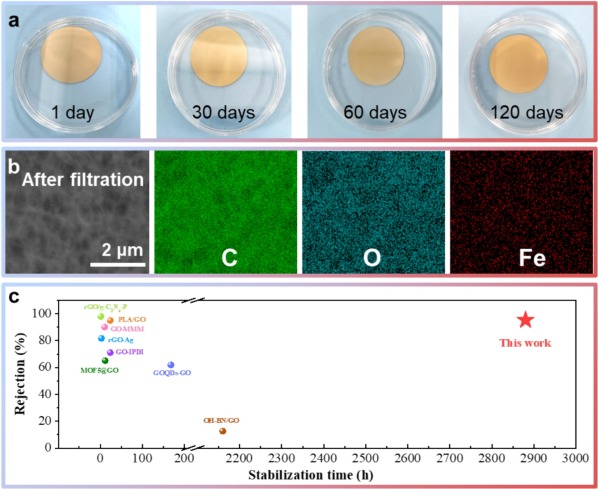
Graphene oxide (GO) membranes, distinguished by their precisely tunable interlayer nanochannels and abundant oxygenated functional groups, exhibit remarkable potential for trivalent rare earth element ions (REE3+) sieving. However, their practical deployment in REE3+ recovery is hindered by inherent instability. Here, we engineer ultra-stable GO-based nanofiltration membranes through a facile Fe3+ crosslinking strategy. Microstructural and spectroscopic analyses reveal that Fe3+ crosslinking induces a predominantly amorphous architecture, rather than ordered crystalline domains. This architecture synergistically locks interlayer spacing at 0.73 nm (optimal for hydrated REE3+ sieving), while maintaining anti-swelling stability through covalent Fe-O dominated bonds. Consequently, the optimized membrane achieves a 4.75-fold increase in Y3+ rejection (from 20 % to 95 %) compared to the pristine GO membrane, with exceptional anti-swelling stability under harsh conditions (90 °C, pH 2–12, 8 bar). Crucially, even after 120 days of continuous high-pressure operation, the rejection efficiency is sustained above 95 % with no discernible swelling. This work not only resolves the long-standing stability-selectivity trade-off in GO membranes but also establishes a ‘coordination lock’ paradigm for designing advanced membrane materials for critical resource recovery.
Keyword / 关键词
Graphene oxide membrane; Nanofiltration; Crosslinking structure; Rare earth elements